Legacy System Retirement
Cerner Data Archiving
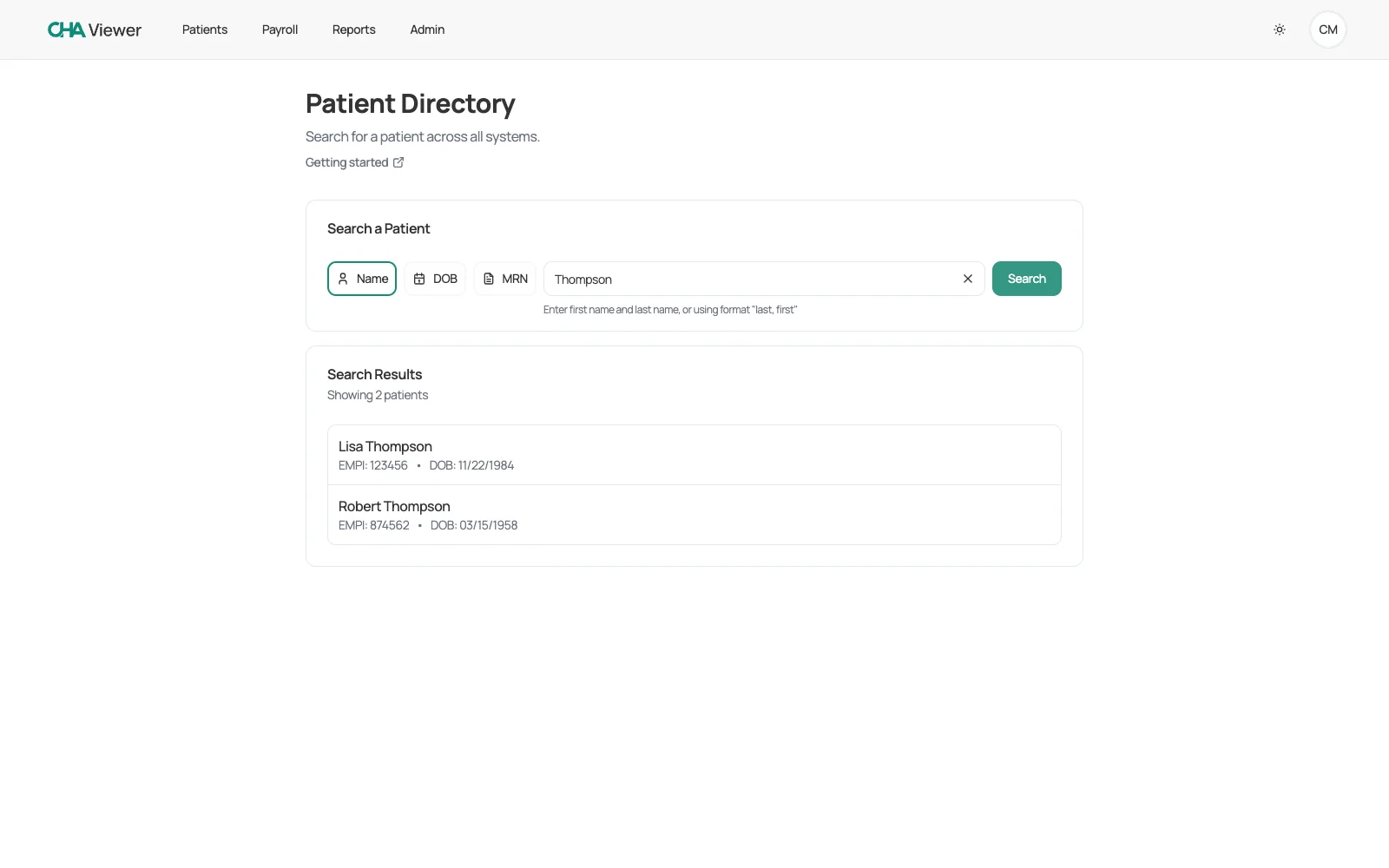
Leaving Cerner Millennium or CommunityWorks — now sold by Oracle Health — means getting decades of history out of a hosted domain before your access to it ends. CHA plans the extract, proves it is complete, and keeps every record searchable in CHA Viewer afterward.
The Source Data
What a Millennium Archive Has to Capture
Cerner's data model is why these projects are harder than they look. Six realities decide whether an extract becomes a usable archive or an unreadable pile of files.
Identifiers Live in Alias Tables
The MRN and the encounter FIN are aliases attached to the person and the encounter, not fields on the chart. Earlier conversions leave retired aliases behind. Keep all of them — release-of-information requests arrive with whatever number was on the original paperwork.
Most of the Chart Is One Event Table
Labs, vitals, assessments, and most documentation are stored as clinical event rows, not as separate per-department tables. A readable chart requires rebuilding the event hierarchy, not just exporting tables.
Nearly Everything Is a Numeric Code
Millennium resolves result names, order types, locations, and statuses through code value tables. An extract delivered without its code sets is a spreadsheet of integers no HIM director can read or defend.
Note Text Sits in Separate Blob Storage
Document and report content is held apart from the event row that points to it. A table dump that skips blob content produces a chart with every heading and none of the narrative.
Scanned Records May Not Be in Cerner
Consents, outside records, and signed forms are often kept in a separate document imaging system. That is a second extract, a second validation pass, and often a second vendor.
Revenue Cycle Is Its Own Extract
Patient accounting and financial data — including Soarian Financials at hospitals that ran it — comes out separately from the clinical record, with its own retention clock for cost report and payer audit support.
What usually turns up in a Cerner decommissioning inventory:
Millennium clinical solutions
Other Cerner-family systems
Usually alongside them
Failure Modes
Where Cerner Archiving Projects Go Wrong
All four of these are recoverable while the contract is live, and expensive or impossible once it is not.
The extract is scoped after the notice goes out
For remote-hosted and CommunityWorks sites the database is not on your floor, and access to it is a contract right. Settle extract scope, format, and re-extract rights while the agreement is live.
Only one facility comes out of the domain
A single Millennium domain can serve several facilities and clinics. Scope the request to the domain, then reconcile facility by facility — not against one hospital's totals.
Extended read-only access is mistaken for an archive
Paying to keep a login into the old domain postpones the problem at full price. The retention clock keeps running, the system keeps drifting from your security baseline, and the extract still has to happen eventually.
Validation stops at row counts
Matching counts prove nothing about blob completeness. Pull real charts — a long inpatient stay, an ED visit, a surgical case — and read them end to end before anything is shut off.
Sequence
How the Decommissioning Runs
The calendar that matters is your contract's, not the project plan's. Everything before step four has to finish while you still have access to the source.
Inventory the domain and the retention clock
Start hereList every Millennium solution in use, every standalone system holding records the domain does not, and the retention rule for each record type. Minors' records usually set the longest clock in the building.
Settle the extract in writing
Before you give noticeAgree what the extract contains, what format it arrives in, and what happens if a gap turns up after termination. This is the highest-leverage step in the project.
Load, reconcile, and read real charts
After deliveryReconcile per facility and per record type, then have HIM, billing, and compliance staff work live requests out of the archive while the source is still there to check against.
Cut over and decommission
Before the contract endsMove release of information, payer audits, and chart lookups to the archive, then retire the subscription, the interfaces, and the accounts still pointing at the old domain.
Inventory the domain and the retention clock
List every Millennium solution in use, every standalone system holding records the domain does not, and the retention rule for each record type. Minors' records usually set the longest clock in the building.
Settle the extract in writing
Agree what the extract contains, what format it arrives in, and what happens if a gap turns up after termination. This is the highest-leverage step in the project.
Load, reconcile, and read real charts
Reconcile per facility and per record type, then have HIM, billing, and compliance staff work live requests out of the archive while the source is still there to check against.
Cut over and decommission
Move release of information, payer audits, and chart lookups to the archive, then retire the subscription, the interfaces, and the accounts still pointing at the old domain.
This is the archive-first playbook applied to Cerner. Read the legacy data archiving guide for the version that covers every system.
Due Diligence
Ask These Before You Give Notice
Put the answers in the termination agreement. Ask them of your incumbent vendor and of every archiving vendor you talk to — including us.
- Exactly which tables and record types are in the extract, and which are not?
- Are the code value tables and event-code hierarchy included, or only the numeric codes?
- Is blob and document content included, and in what file format?
- Does the extract cover every facility in the domain, including closed clinics?
- After termination, can we request a corrected or repeat extract — and for how long?
- Will the archive preserve the original MRN and encounter FIN as searchable identifiers?
FAQ
Cerner Archiving Questions
Can we archive Cerner data after our contract ends?
Do you need direct database access to Millennium?
We migrated years ago and still keep Cerner running for lookups. Is it too late?
Who at the hospital needs to be involved?
Has CHA archived Cerner before?
Is CHA affiliated with Oracle Health or Cerner?
Retiring Cerner? Start with the Extract.
Bring us your domain inventory and contract dates. We will tell you what has to be settled before notice goes out — and show you the archive your team uses afterward.